Wednesday, 5 September 2012

Sambharam - Spiced Buttermilk - Moru Vellam

People from Kerala do not eat curd rice. That is a huge difference from the neighbouring states. But that does not mean that curd does not feature in their menu. Lot of dishes have yogurt base. Moru Kari, Pulisheri etc used as kozhambu are yogurt based dishes. Kichadi made with Okra, Pavakka, Beetroot use yogurt base. Some people also just add curd as a side while eating sambar and rice. But the crown of the best use of curd goes to Sambharam.
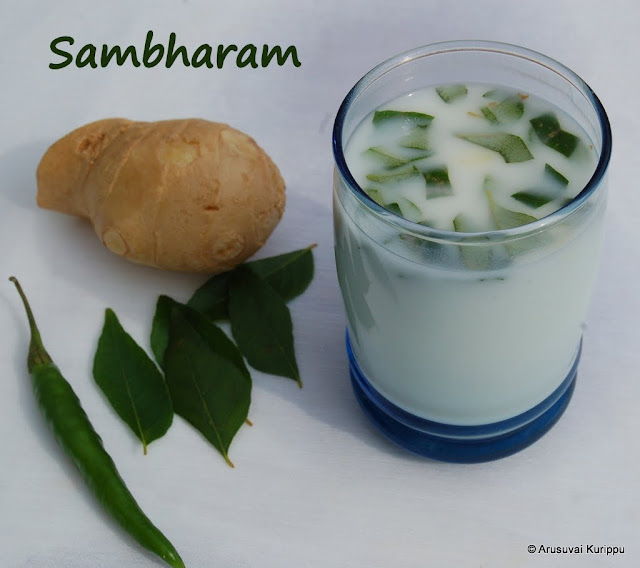


My husband was asking why not just call it Moru (like tamilians), why the fancy name. Well Moru is just plain buttermilk. Sambharam is spiced buttermilk.

On a hot sunny day nothing quenches the thirst like this good old drink. The best taste of this is when you drink it from earthen vessels. But these days (and in the country that I am in) there is no scope for earthen pots. So I have to make do with glasses. And the sad part is the weather is never too warm for me to crave this favourite drink of mine.

When I lived in Chennai a long time ago, when we are out and about (window shopping) in the hot Chennai sun we used to buy packets of this spiced buttermilk and used to drink right out of the packet. It used to just feel divine. Last week we were in Saravana Bhavan and I was eating my favourite there - Kothu Barota. I really felt like having this to compliment the heat from the dish. It was divine, but for the cost. £3 for a glass of moru is too much. I mean I can make around 30 glasses for around a £1 at home.

Ingredients (Makes 3-4 glasses)

Curd 4 tbsp
Water 3 cups
Green Chilli 1
Curry Leaves few
Ginger a very small bit
Salt

Method of Preparation

1. Finely chop green chilli, curry leaf and ginger.

2. Take curd in a vessel. Add the water and salt. Mix well.

3. Add the chopped chillies, curry leaves and ginger.

4. Leave it for sometime before serving. You can remove the herbs before serving or just leave it in. It is upto the person drinking. The buttermilk will be flavoured even if you remove the herbs.

Note:
1. Adjust spice per your taste.
2. If serving for kids, you may want to avoid chillies
3. You can add a little hing for added taste


Linking this to Onam Special @ Sharan's Samayalarai


Tuesday, 4 September 2012

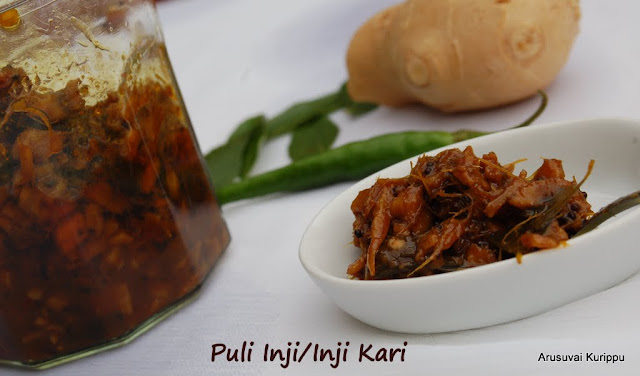
Inji Kari - Puli Inji

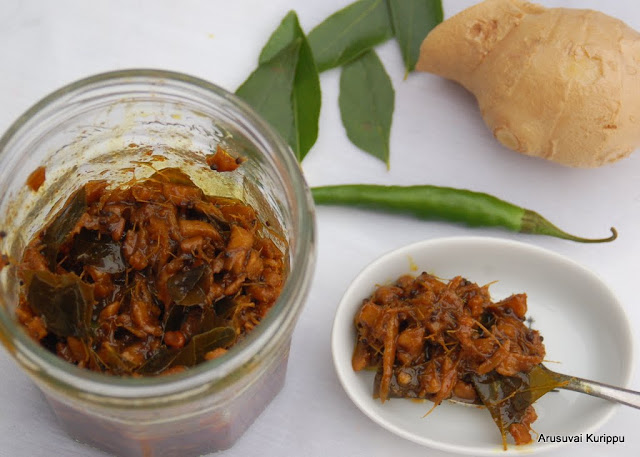
Inji Kari or Puli Inji can be translated as Ginger Pickle. It is basically ginger and green chillies roasted well and then cooked in a tamarind and jaggery sauce.

It is a must in any Kerala feast. If I have to pick one dish out of the 15 or so that I made for Onam, I think I will pick this one. I have not made it since last Onam and am so surprised that I have not. The batch that I made was over the same day. Now I have to make a bigger batch this time.

Ginger has amazing digestive properties. So comes handy when eating a heavy meal.


Ingredients

Ginger finely chopped 1 cup
Green Chillies 2 chopped
Curry Leaves few
Tamarind Paste 2 tsp
Jaggery 1 tbsp
Chilli Powder 1/2 tsp
Turmeric 1/2 tsp
Mustard seeds 1/2 tsp
Fenugreek seeds 1/4 tsp
Hing a 1/4 tsp

Sesame Oil 1/4 cup

Method of Preparation

1. Heat oil in a pan. I recommend a non stick pan. Add the mustard. When it sputters, add fenugreek seeds. When it starts to brown, add the curry leaves.

2. Add the ginger and green chillies. In a medium flame saute till it browns a little. Keep aside.

3. In another pan, heat tamarind paste and 2 cups of water. Add the chilli powder, turmeric powder and hing. Bring to a boil.

4. Add the ginger to this. Boil for a few minutes.

5. Now add the jaggery and cook till it all comes together and most of the water is drained. Some people keep it watery. I like mine a little bit on the drier side.

Store in an airtight container.


Linking this to Onam Special @ Sharan's Samayalarai


Monday, 3 September 2012

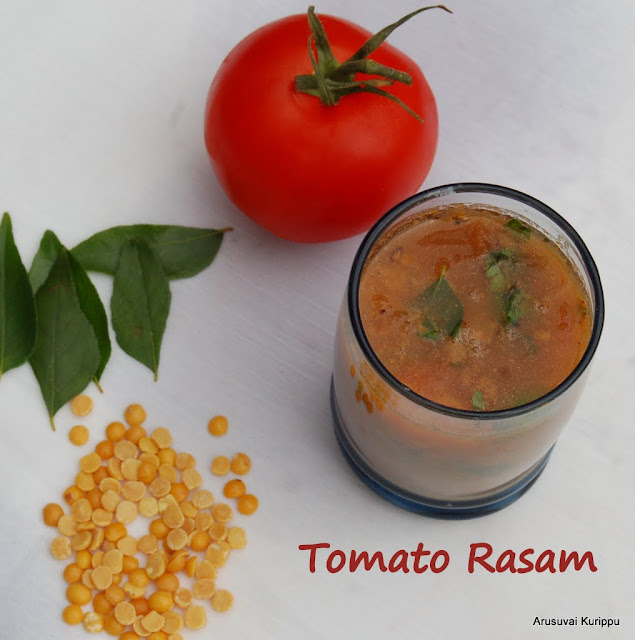
Tomato Rasam

Rasam, as I have mentioned in my earlier Rasam posts, can be made in so many differences. For an amateur, I used try different rasams and they all used to taste the same. But with time I have learned to make Rasam that has distinct taste. Though it sounds an easy recipe to make Rasam, I believe Rasam making in an art...

This one is my go to Rasam. You can't make much mistakes in this one. I served this in my Onam meal. Hope you enjoy it.


Ingredients

Tomato 2
Rasam Powder 2 tsp
Tamarind Paste 1/2 tsp
Toor Dal water 1/2 cup (or 1/8 cup of dal cooked in water)
Hing a little
Ghee 2 tsp
Mustard seeds 1/2 tsp
Curry Leaves few
Jeera 1 tsp
Coriander leaves a little

Method of Preparation

1. Heat a pan and add tomatoes along with 1 cup of water.

2. When tomatoes are cooked, add tamarind paste, rasam powder and salt.

3. After it is boils for a few minutes, add the dal water. Usually if you are making rasam and sambar, the water of the dal is used in Rasam and dal part in sambar. Otherwise you can just cook a little dal and whisk it into a clear water and add.

4. When it froths up, switch off.

5. In a small pan, add ghee. Add mustard. When it sputters, add jeera and curry leaves.  Add this to the rasam.

6. Garnish with coriander leaves.

Check out other Rasam Varieties in my blog!
  1. Mysore Rasam
  2. Lemon Rasam
  3. Jeeraga Milagu Rasam (Cumin-Pepper Rasam)
  4. Mint Rasam - Pudina Rasam
Linking this to Lets Cook - Lentils and Legumes Event by Radhika
Linking this to Onam Special @ Sharan's Samayalarai


Sunday, 2 September 2012

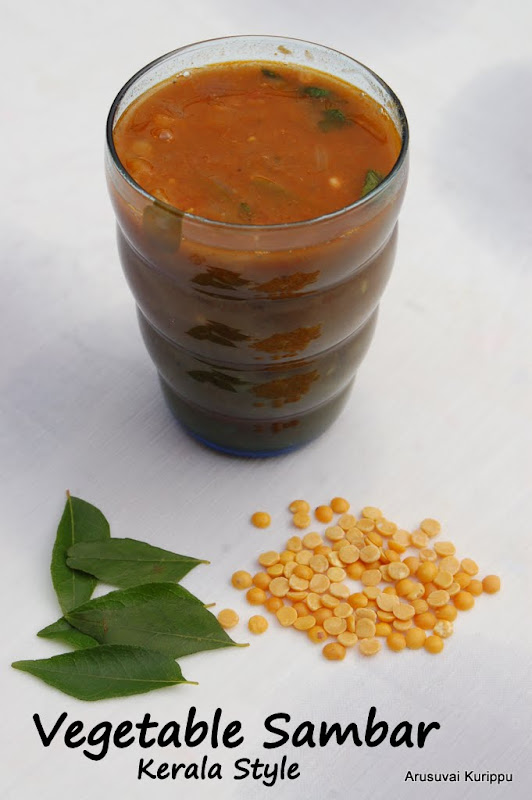
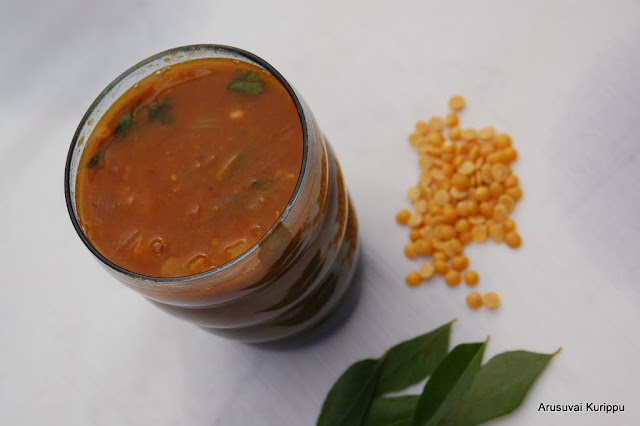
Vegetable Sambar - Kerala Style Sambar

Sambar is an essential part of a South Indian meal. Though cooked in all the states (and by many north indians as well), they have unique recipes. As I mentioned in an earlier post, my favourite sambar is the Kerala Style sambar. It could be cause my mom makes the Tamil Style sambar and we eat it everyday. Kerala sambar we eat on special occasions. Though I know the taste and have an idea of how to make it, I had never been able to perfect the taste. This Onam I was able to make a Sambar that was perfect for me. This will be the sambar that will be made at our home from now on!


Ingredients

Toor Dal 1/2 cup
Potato 2
Carrot 1
Vendakka 7
Onions 1
Tomato 2
Green Chillies 1 (add more for a nice spicy sambar)
Tamarind paste 1 tsp
Curry Leaves few
Sambar powder 3 tsp
Hing a little

Oil and Salt to taste

Method of Preparation

1. Cook the toor dal with a couple of cups of water in a pressure cooker till is mushed up well.

2. In a pressure cooker, heat some oil. Add onions. Saute for a minute. Add curry leaves and green chillies

3. Add potatoes, carrots, vendakka all cut into big pieces. Saute for another minute

4. Add the tomatoes,  tamarind paste, sambar powder and mix well.

5. Add the cooked dal. If needed add some more water. (I added 1 cup of water).

6. Pressure cook for 2 whistles.

Garnish with coriander leaves (optional). Sambar is ready to be served with rice


Linking this to Lets Cook - Lentils and Legumes Event by Radhika
Linking this to Onam Special @ Sharan's Samayalarai


Kerala Sadya Recipes - Onam Special

As we celebrate Onam this week (Thiruvonam on 29th Aug 2012), I thought I will compile a page in an effort to showcase the items that are served in Kerala Feast. Many of this is true for a Tamil Feast as well. But they are not all applicable.

The banana leaf is usually used to serve Kerala Feast. The top portion is used to serve different curries and bottom side is used for rice, sambar, snacks, payasam etc. The leaf usually used should be the end leaf (nuni ela) with the smaller end on the left of the person sitting in front.


The order of serving 

On the top from right to left - Kichadi, Pachadi, Thoran, Mizhukkuparatti, Avial/Kootu, Achar(Pickle)

On the bottom payasam at the right corner. rice in the middle (with parippu, sambar, nei etc), on the left corner - banana chips, sharkara varatti, pappadam, pazham

I have a lot of recipes in my blog. But still not the complete collection. I will update the page as and when I post all the recipes. 

Want to read more? Looking for the recipes to fit the Plate... Click on this link to be taken to an array of Traditional Kerala Feast Recipes